


- By Jaideep Deshmukh
- 29 Jan, 2026
The Future of Transport & Logistics: Building an AI-Powered Enterprise Decision Fabric
Executive Overview: The intelligence imperative
Most CEOs in transport and logistics recognise a quiet contradiction.
Volumes are growing. Dashboards are largely green. Yet decision-making feels heavier, slower, and more fragile than it did a few years ago. This is not a failure of execution. It’s a signal that the system behaves differently at today’s level of scale and volatility.
What once delivered advantage, network size, operational discipline, layered processes, now introduces friction. Complexity accumulates faster than leadership attention can absorb it. The result is not visible failure, but reduced confidence: more exceptions, more escalations, and less certainty that the organisation is truly under control.
This is the environment leaders are navigating now—not episodic disruption, but continuous strain.
The Current State: A System Under Unprecedented Strain
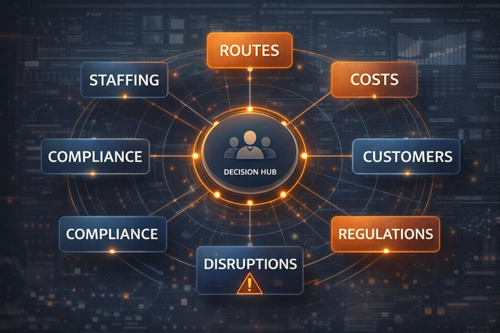
Across the industry, volatility is no longer an event; it is the baseline.
-
Sustainability targets pull against cost pressures
-
Customer expectations rise faster than physical capacity
-
Regulatory requirements multiply faster than compliance teams can respond
Individually, none of these are new. Collectively, they expose a deeper issue: the operating system was designed for stability, not permanent variability.
As networks grow, so do handoffs, decision points, and exceptions. Most organisations respond by adding dashboards, reports, and controls. In practice, this increases cognitive load without improving clarity. Leaders spend more time interpreting signals and less time acting with confidence.
This is where scale quietly turns into risk.
What Still Works; and Why It Might Not Be Enough ?
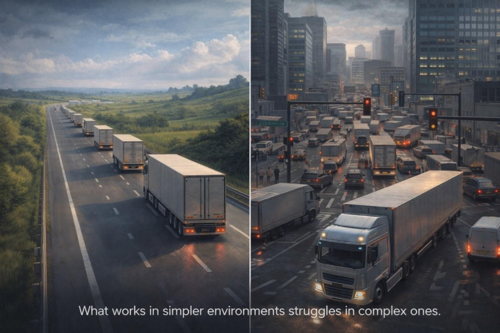
The industry’s strengths remain real: disciplined operations, deep experience, and finely optimised processes. The issue is not that these systems are wrong, but that they are brittle under new conditions.
Highly optimised systems perform well within expected ranges. Under novel combinations of constraints, labour shortages, regulatory changes, weather events, demand spikes, small deviations propagate quickly. Workarounds emerge. Decision rights blur. Firefighting becomes normalised.
At this point, performance depends less on system design and more on individual heroics. That is not a sustainable leadership position.
Decision Saturation: the hidden constraint on growth
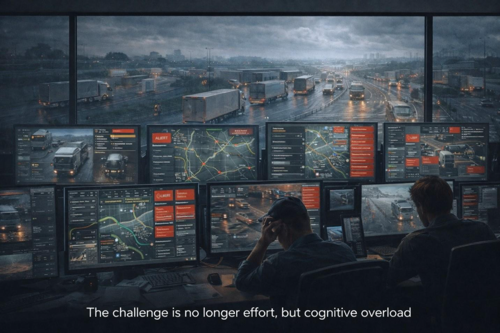
Many CEOs describe the same pattern:
they are pulled into more operational decisions than ever before, despite larger teams and more data.
The problem is not information scarcity. It is decision saturation.
As complexity increases, the number of decisions that could be made outpaces human capacity to make them well. Additional data often worsens the situation by increasing noise without improving prioritisation. The real bottleneck shifts from execution capacity to decision quality under pressure.
Traditional tools were not built to resolve this.
AI as decision infrastructure, not automation
In this context, AI matters for a very specific reason.
Properly designed, it does not replace people or automate tasks for their own sake. It acts as decision infrastructure—absorbing computational complexity so human leaders can focus on judgment, trade-offs, and accountability.
Poorly implemented AI adds opacity and erodes trust.
Well-implemented AI creates earlier signal detection, clearer reasoning paths, and confidence to delegate without losing control.
The distinction is not technical. It is architectural.
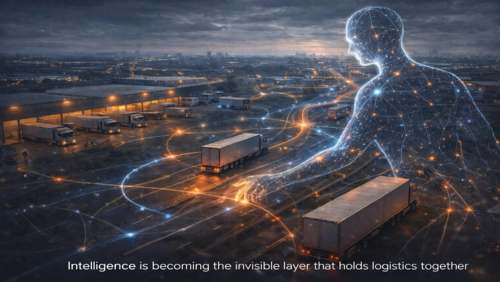
Five AI Capability Shifts Reshaping Transport & Logistics
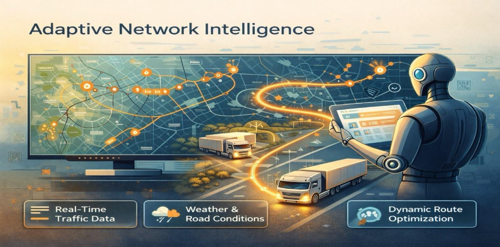
Adaptive Network Intelligence
-
Industry problem: Traditional network optimization assumes stable conditions.
-
Why traditional approaches fail: Static models can't adapt to real-world volatility; leaders are stuck in reactive firefighting.
-
How AI changes the decision environment: Creates a continuously learning model that treats disruption as the norm.
-
Strategic relevance for Transport & Logistics Leaders: Shifts network management to a proactive source of competitive resilience.
-
Enterprise benefit: Fewer surprises, faster reconfiguration, and reduced disruption costs across the network
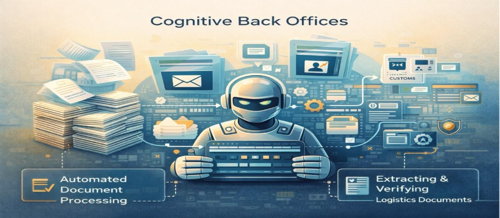
Cognitive Back Offices
-
Industry problem: Administrative complexity consumes leadership attention.
-
Why traditional approaches fail: Legacy systems and manual processes are error-prone and cannot scale with regulatory complexity.
-
How AI changes the decision environment: AI systems understand context and intent, transforming compliance, documentation, and reporting into strategic assets.
-
Strategic relevance for CEOs: Frees senior talent from administrative burdens, enabling focus on crucial relationships and strategic opportunities.
-
Enterprise benefit: Lower administrative drag, faster compliance cycles, and reduced dependency on manual oversight
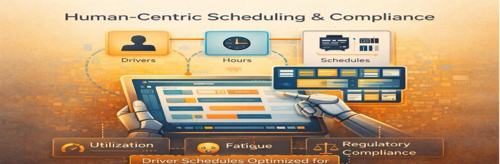
Human-Centric Scheduling & Compliance
-
Industry problem: Scheduling optimized purely for efficiency leads to driver shortages, burnout, and compliance issues.
-
Why traditional approaches fail: Rigid scheduling ignores human factors.
-
How AI changes the decision environment: Balances operational requirements with human factors, regulatory limits, and personal preferences.
-
Strategic relevance for CEOs: Builds a sustainable and loyal workforce.
-
Enterprise benefit: Improved workforce stability, lower attrition risk, and more predictable service delivery
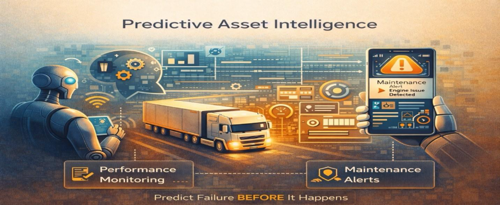
Predictive Asset Intelligence
-
Industry problem: Unplanned maintenance and asset failure cause disruption.
-
Why traditional approaches fail: Preventive maintenance is calendar-based, not condition-based.
-
How AI changes the decision environment: Anticipates failures before outward symptoms appear, transforming capital allocation from reactive to proactive.
-
Strategic relevance for CEOs: Maximizes asset life and improves capital allocation.
-
Enterprise benefit: Better capital utilisation, fewer unplanned outages, and more reliable asset availability

System-Verified Operations
-
Industry problem: Leaders lack confidence in distributed operations.
-
Why traditional approaches fail: Manual audits are slow and limited; escalation protocols trigger too late.
-
How AI changes the decision environment: Provides continuous verification, flagging anomalies.
-
Strategic relevance for CEOs: Enables effective delegation while maintaining full visibility and control.
-
Enterprise benefit: Confident delegation at scale with continuous visibility and control
What the Future Holds: Effort powered with Foresight
The future belongs to leaders who prioritize foresight powered effort. Calm, anticipatory leadership replaces frantic reactivity. AI-enabled systems provide earlier risk visibility, allowing strategic response rather than tactical scrambling.
Learning systems accumulate institutional knowledge that survives personnel changes, creating organizations that grow wiser with experience rather than repeating past mistakes.
What This Means for Transport & Logistics Leaders
The competitive advantage in transport and logistics is shifting away from scale alone toward enterprise-wide decision intelligence.
As networks grow more complex, value is no longer created by adding capacity or optimising individual functions in isolation. It comes from how effectively organisations sense change, interpret signals, and act early across the enterprise. This is where AI, applied deliberately, becomes decisive.
In practice, this means embedding AI-powered intelligence into the areas that absorb the most friction today:
-
Network operations, where early signal detection prevents disruption rather than reacting to it
-
Planning and scheduling, where human, regulatory, and operational constraints must be balanced continuously
-
Asset and fleet management, where condition-based insight outperforms calendar-based assumptions
-
Compliance and back-office operations, where context-aware systems reduce latency, rework, and escalation
When intelligence is embedded at these pressure points, organisations move from reactive coordination to anticipatory control. Exceptions surface earlier. Trade-offs become visible sooner. Capital and effort are allocated with greater precision.
The result is not wholesale automation, but a more responsive enterprise operating system—one that learns from volatility instead of being destabilised by it.
Only at this point does the leadership impact become visible. With AI handling computational complexity and pattern recognition at scale, leaders regain the ability to delegate with confidence, intervene selectively, and focus human judgment where it adds the most value.
In this new environment, advantage does not come from working harder at complexity, but from seeing earlier and deciding better. Organisations that build AI-powered decision intelligence into their core operations will not just cope with volatility—they will convert it into a structural advantage.

 19 Jan, 2026

